Present in 19 countries

Spatial injustice and mobility: beyond a simple feeling of remoteness

What does it mean to feel an injustice linked to where you live or how you travel? To answer this, the researchers surveyed a representative sample of 4,000 people in France about their concrete experience of injustice. The conclusions go beyond the received wisdom that mobility is a magic wand capable of erasing distance.
How does injustice shed light on mobility challenges? Jacques Lévy & Martin Vanier
In this interview filmed at the event organised in April 2026 by Geonexio, the think & do tank of Transdev in France, Jacques Lévy and Martin Vanier present the findings of research into perceptions of justice and injustice in France. Based on a survey of 4,000 people, this work highlights the diversity of citizens' experiences and expectations, as well as the role of local areas and of collective participation in building fairer, more inclusive solutions.
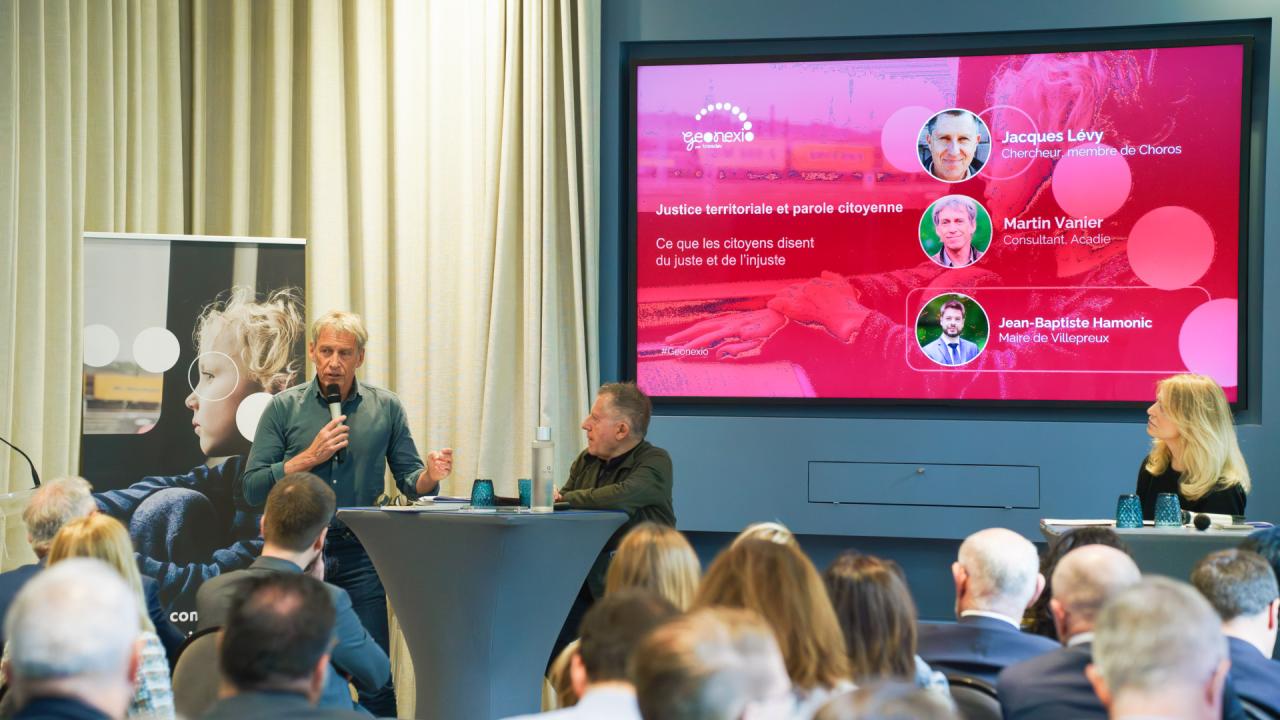
Jacques Lévy (Researcher, member of Chôros): "We worked on justice, but also specifically on injustice, by asking a representative sample of the French population, comprising 4,000 respondents, what injustices they had experienced and what their personal experiences of injustice had been. This revealed a truly striking landscape of diversity, as well as suffering." Martin Vanier (Consultant, Acadie): "And in conclusion to this work, I believe the most important takeaway is that there is no longer a shared ability to unite around a single, dominant conception of what is fair and what is unfair today." Jacques Lévy: "We are now dealing with a more fragmented landscape, approached through the perspective of the individual, which was inherent in the logic of the question, but which remains highly individual for many people." Martin Vanier: "Far more often than one might expect, people are not expressing a simplistic expectation along the lines of: 'I live far away, but that's okay, mobility will solve all the problems associated with distance.' To me, the major geographical differences that give justice its spatial dimension are not so much reflected in statements such as, 'It's unfair because I live here.' Well, of course, living here is different from living elsewhere. Rather, they lie in whether I can find, within my territory, opportunities to participate in collective solutions that make things fairer, or whether those opportunities are absent. This is where differences between territories emerge. They are expressed very strongly by elected officials, but also by citizens, and that is what constitutes the spatial dimension of justice." Fournissez vos commentaires sur BizChat
A fragmented landscape of experiences
The work looked at justice, but also specifically at injustice, by asking respondents which injustices they had experienced.
There is no longer a single, dominant conception of what is just and unjust. Experiences have become highly individual, diverse, and sometimes marked by real suffering.

“This paints a truly striking picture of diversity, and of suffering too.”
Spatial injustice, a matter of collective action
Geographical inequity lies less in the fact of living far from city centres than in the ability, or inability, to find the means to act within one's own local area.
Living far away while counting on mobility to solve every problem of remoteness reflects an expectation the survey does not confirm. The spatial dimension of justice plays out elsewhere, and these differences between local areas are strongly expressed, by elected representatives and citizens alike.
“The major geographical differences that give justice a spatial dimension lie in whether or not I find, within my own local area, the possibility of taking part in the collective solutions that make things fairer.”
To build fairer mobility policies, it is not enough to add kilometres of routes: citizens and elected representatives must be given the means to be actors in the solutions for their own living area.
Eco-friendly website
Latest page modification date :
B
This page is times lighter than average
Emissions from this page
Estimated calculation per visit
0.1
in grams
of CO2 equivalent
of CO2 equivalent