Present in 19 countries

Inter-urban mobility: the blind spot of the ecological transition?

Everyday journeys between metropolitan areas and medium-sized towns concern only around 10% of working people, yet they account for nearly 30% of CO2 emissions from home-to-work travel. The work carried out by the Ville Mobilité Transport laboratory for Geonexio sheds quantified light on these invisible but decisive flows.
How is inter-urban mobility changing? - Anne Aguiléra & Florent Le Néchet
In this interview filmed at the event organised in April 2026 by Geonexio, the think & do tank of Transdev in France, Anne Aguiléra and Florent Le Néchet analyse the challenges of inter-urban mobility and its impact on how local areas are organised. Drawing on their research, they highlight the significance of daily journeys between towns, strong car dependency and the need to develop more sustainable alternatives to meet mobility, spatial planning and emissions reduction challenges.
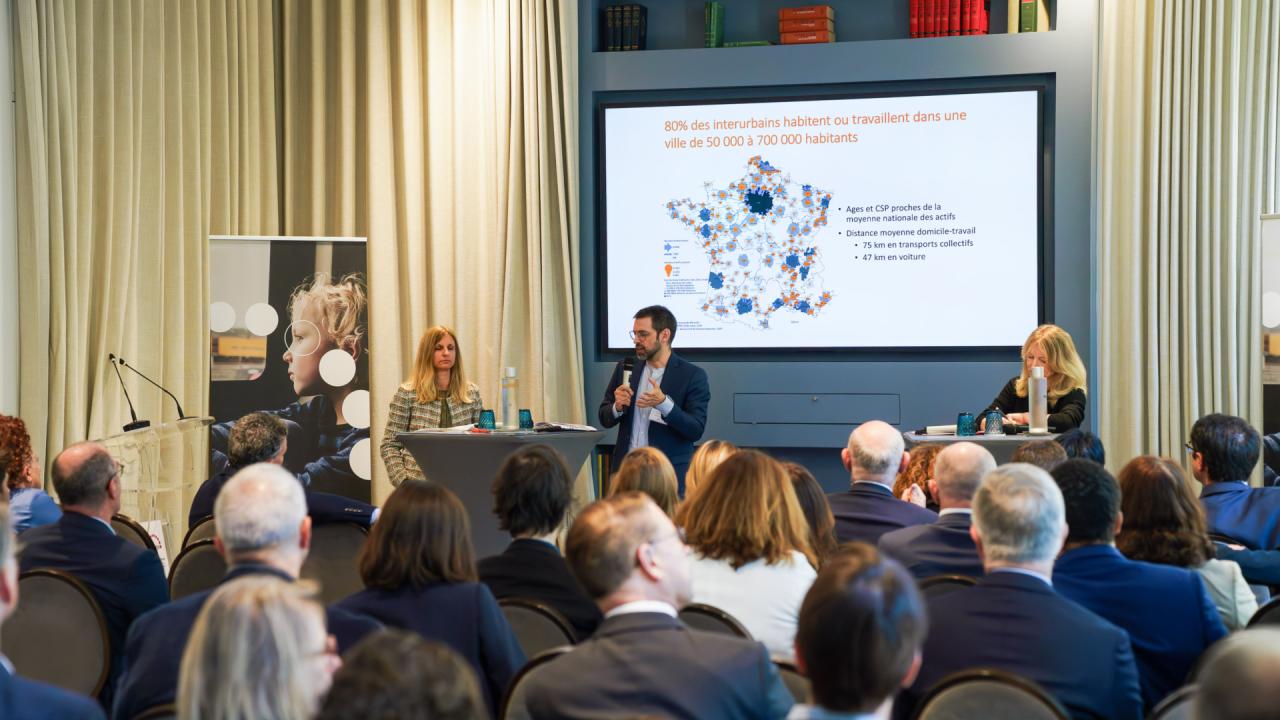
Florent Le Néchet (Associate Professor at Gustave Eiffel University, Deputy Director of LVMT): “In this work, we defined interurban mobility as trips, particularly commuting trips, that take place between two cities as defined by INSEE. INSEE defines what it calls city attraction areas, which are functional areas made up of several municipalities. These areas are designed so that a significant share of trips takes place within their boundaries, particularly towards the core city of the urban area, where most jobs are generally concentrated.” Anna Aguilera (Director of the City Mobility Transport Laboratory - LVMT): “One very important issue is that our research shows that interurban travel flows involve 3 million people, and more than 90% of them use a car every day to commute to work over relatively long distances. This means there are major challenges, and opportunities, in encouraging a shift towards alternatives to private car use.” Florent Le Néchet: “According to our calculations, these commuting patterns account for a little over 10% of the workforce and around 30% of CO₂ emissions. The explanation is quite straightforward: because these trips extend beyond the boundaries of urban areas, their average distances are naturally longer than trips made within cities. Beyond these aspects, interurban mobility is also important to consider in the broader context of regional development projects. In fact, we are seeing that interurban mobility plays a significant role in the organization and functioning of territories at a subregional scale, while extending beyond the traditional boundaries of cities. It therefore raises a whole range of interconnected planning challenges involving housing, employment, and, of course, transport and mobility.”
What inter-urban mobility covers
Journeys are classified as inter-urban, home-to-work travel in particular, when they take place between two towns as defined by INSEE, the French national statistics institute. INSEE defines urban catchment areas: functional perimeters made up of several municipalities, drawn so that a significant share of journeys takes place within them, and in particular towards the core city of the conurbation, where most jobs are concentrated.
Inter-urban mobility is therefore travel that crosses these limits to reach another employment area.
Long journeys, heavily dependent on the car
These flows concern three million people. The reason for their carbon weight is mechanical: leaving the urban perimeter means average distances that are considerably longer than journeys made within conurbations.

“Our work shows that inter-urban flows concern 3 million people, and that more than 90% of them take the car every day to get to work over long distances.”
Rethinking spatial planning at infra-regional scale
The challenge does not concern transport services alone. Inter-urban mobility occupies a place in the organisation and functioning of local areas at an infra-regional scale, which goes beyond the classic perimeter of cities.

“There is a whole series of interlinked planning challenges here, whether housing, employment and of course transport and mobility.”
Eco-friendly website
Latest page modification date :
B
This page is times lighter than average
Emissions from this page
Estimated calculation per visit
0.1
in grams
of CO2 equivalent
of CO2 equivalent