Present in 19 countries

Vocads
The voice at the service of the traveler experience

Voice innovation serving passenger experience
Transdev is exploring new ways to interact with its customers, and the Vocads solution is fully in line with this approach.
This innovative platform transforms traditional surveys into natural voice conversations, powered by artificial intelligence. Accessible via phone, web, email, or directly onboard vehicles, Vocads is easy to deploy, multilingual, and available 24/7.
A major advantage: Vocads can be deployed anywhere in the world, enabling the harmonisation of practices and offering a consistent experience on an international scale.
Objectives and benefits
- A smoother and more inclusive experience, with a satisfaction rate above 80%.
- Verbatim responses up to 5 times richer than traditional surveys.
- Automated analysis of responses, instantly generating reports and recommendations at no additional cost.Increased team productivity (+52%), allowing teams to focus on high‑value tasks.
Vocads has already been tested at various customer touchpoints (agencies, emails, onboard) to collect traveller feedback.
Pilot programs have been conducted on major networks such as Rouen and Reims, as well as on smaller networks, in order to test the solution in diverse contexts and confirm its flexibility.
These initiatives demonstrate Transdev’s commitment to integrating advanced technologies to enhance the customer experience.
In summary, Vocads illustrates Transdev’s ability to anticipate traveller expectations and offer innovative solutions focused on simplicity, quality, and inclusion, with global reach.
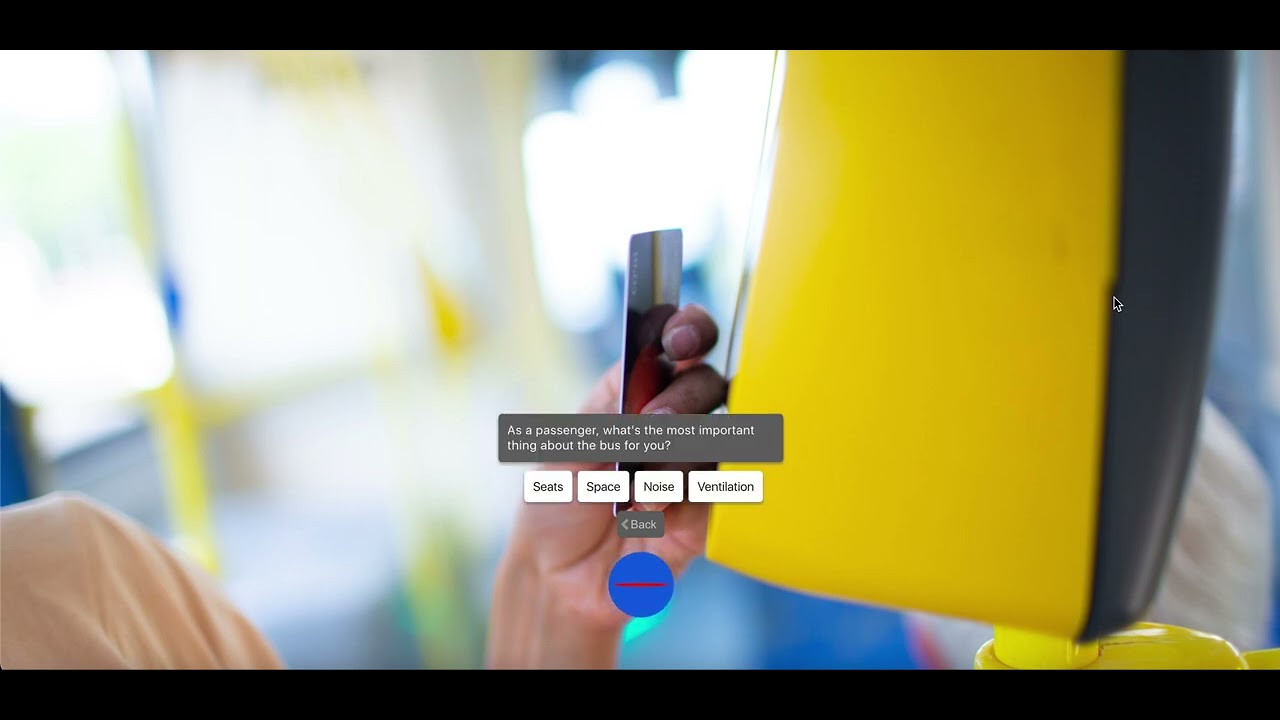
Satisfaction Survey: User Experience with the New Buses The video features a dialogue between an automated survey system and a passenger, covering several aspects of the service. 1. Comfort and Overall Design The passenger gives very positive feedback on the evolution of the service: Comfort: He notes that the improvements made to comfort are “really great” [01:12:00]. Design: The new vehicle design is described as pleasant, and the fleet renewal is seen as an excellent initiative [01:12:20]. 2. Interior Layout and Space This is where the passenger expresses significant reservations: Seat layout: He is “not really convinced” by the new seating configuration [01:12:44]. Space optimization: He feels that there are fewer seats and, paradoxically, less standing room as well. He concludes that the layout does not seem optimally designed [01:12:49]. 3. Survey Conclusion The automated system assures the passenger that his comments about seat layout will be shared with the technical teams. The emphasis is on the importance of user feedback for the continuous improvement of public transport services [01:13:06]. Suggestions for Your Article Potential Title: New Buses: When the Design Impresses but the Interior Space Raises Questions Angle: You can highlight the importance of real‑time satisfaction surveys for guiding future improvements in public transport design. Focus: The contrast between an attractive exterior design and the practical constraints of passenger density.
Eco-friendly website
Latest page modification date :
D
This page is times lighter than average
Emissions from this page
Estimated calculation per visit
0.23
in grams
of CO2 equivalent
of CO2 equivalent