Present in 19 countries

Profile: Everyday mobility lessons from a self-confessed public transport lover


Expert Dr Barbara Lenz talks to the Mobility Times about mobility integration, her passion for public transport and movies involving hard choices – and her small dog
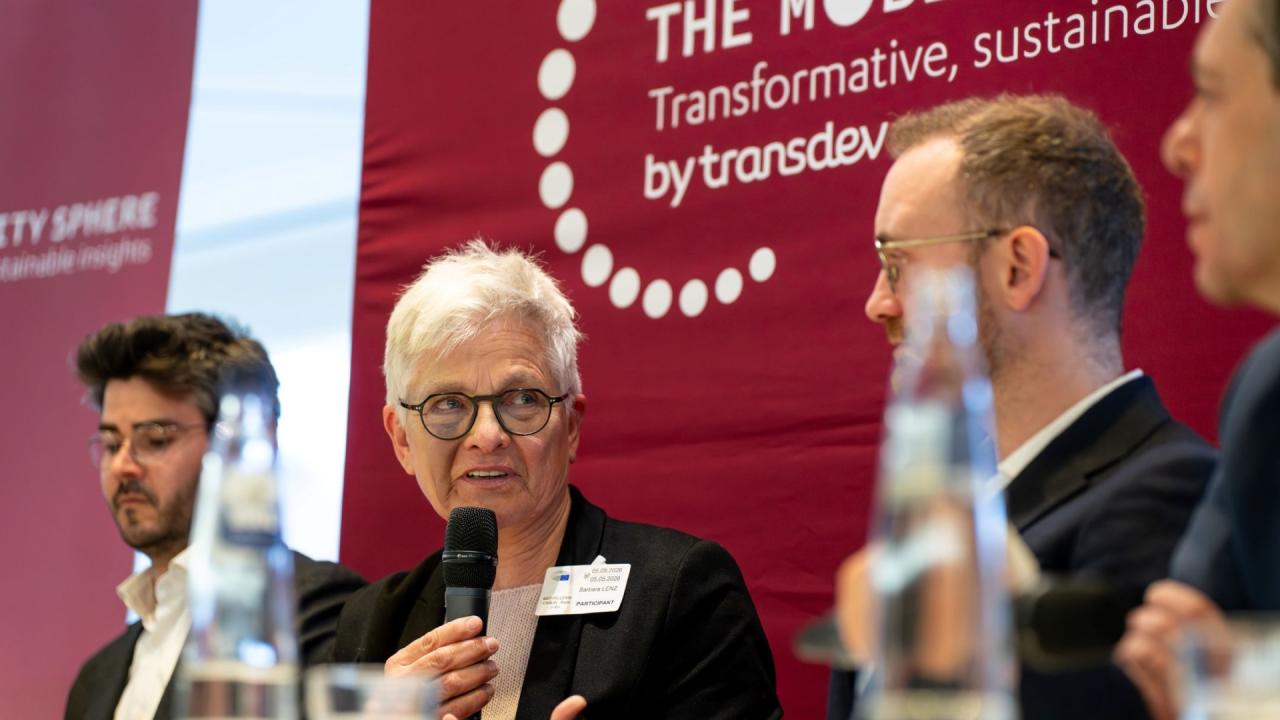
0:00 Public transport will become increasingly important across Europe, not only in cities but also in rural areas. 0:14 The transformation taking place in Europe is occurring on several levels. First, there is the technological transition, driven primarily by the shift from fossil-fuel-based mobility to electric mobility. 0:26 Today, around 60% of buses used in public transport across Europe operate either on alternative energy sources or on electricity. 0:35 Another aspect of this transformation concerns people's behaviour. More and more citizens are showing interest in alternative modes of transport, particularly shared mobility and public transport. 0:51 There is also a transformation in the way public transport becomes accessible through software, digital tools and new services. 1:00 While some projects already exist across Europe, this evolution has not yet taken place on a large scale through strategic partnerships. 1:08 I believe this is what Europe truly needs. 1:15 Strong strategic alliances between the hardware, software and mobility service industries.
Barbara Lenz thinks in systems, but has a knack for making everyday moments special: the steady rhythm of a city tram, walking the dog around her central Berlin neighbourhood or in surrounding nature, the lingering impression of a film that inspired her because it shows people facing difficult decisions.
Lenz’s career has taken her from freight logistics to the heart of Europe’s transport policy debates.
It is perhaps because the former director of the German Institute of Transport Research in Berlin, and Professor of Transport Geography at Berlin’s Humboldt University has deep-dived into so many different topics that she argues insistently for integration, standards and policies that reflect mobility as a social question, and bring together best practices from various fields.
“You cannot think about transport without thinking about people’s everyday lives,” Lenz told the Mobility Times in an interview in the aftermath of the Mobility Sphere’s conference at the European Parliament in Brussels in May 2026.
She makes no secret of her love of public transport, which seems to be where her public mission and private pleasure converge.
I’m a real fan of Berlin public transport,” she says “It’s simply always there — I don’t have to think; I can just get on.”
That intimacy with transit explains her preference for systems that are reliable, for vehicles and timetables that meet the rhythms of people’s routines – although she admits, with a chuckle, “that I can’t infect everybody with my enthusiasm for public transport”.
Her path into transport research began with goods: “I came to the topic of mobility via freight transport. I did my doctoral and habilitation work on internationalisation of production… and that only worked and continues to work because of developments and advances in transport.”
From horticulture shipments requiring refrigeration to fleets and timetables, she followed the chain from technical fix to social consequence. That chain led her to head a major German transport institute, to advise European projects on automation, and to insist on regulatory fixes that ordinary commuters — and ordinary politicians — sometimes overlook.
So what does she think Europe can do better as it prepares the future of mobility?
Harmonised technical requirements across the bloc is one area, she responds, interoperable ticketing is another.
More than anything, she hopes that manufacturers, software providers and operators can learn to work together much more closely, right from the planning stage of any mobility enterprise.
“There are manufacturers who build their vehicles almost independently of which software will later run on them,” she says. Those separate worlds — hardware, software, service — need a new means of cooperation, she argues.
Mobility manufacturers and operators could, Lenz believes, learn something from the software sector whose credo is to move towards standardisation as much as possible and then add modular specifications on top, “rather than operating in a highly specific way from the outset”.
Lenz’s life in Berlin — “I live 50 meters from the Kurfürstendamm” — and her daily routines matter to her argument. The Papillon dog she walks and the cinema she loves are evidence of how mobility interacts with culture, leisure and domestic rhythms. “I especially like films that portray life situations someone has to cope with — whether they succeed or sometimes fail,” she explains – a description that could work just as well for mobility challenges as for movie plots.
In what areas does she feel Europe is already doing well? Lenz said she admires the EU’s role in standardising rail systems, and would like to see the same ambition applied to bus networks and ticketing: “If everyone uses the same terminology, they are talking about the same thing. That is an important task only the EU can undertake. It cannot come from the national level.”
She also feels that European data protection is exemplary.
Although her career has already spanned decades, Lenz is poised to travel much further still on the road to a better mobility future for Europe, thanks to her blend of scholarly depth and civic enthusiasm.
Taking the bus, walking the streets and taking in a film provides the scholar with daily feedback as she ponders the central question: Is our transport fit for the way we live?
A question, she knows only too well, that is far from settled.
Eco-friendly website
Latest page modification date :
B
This page is times lighter than average
Emissions from this page
Estimated calculation per visit
0.1
in grams
of CO2 equivalent
of CO2 equivalent