Present in 19 countries

Mobility and the Growing Territorial Divide: Mind the Gap

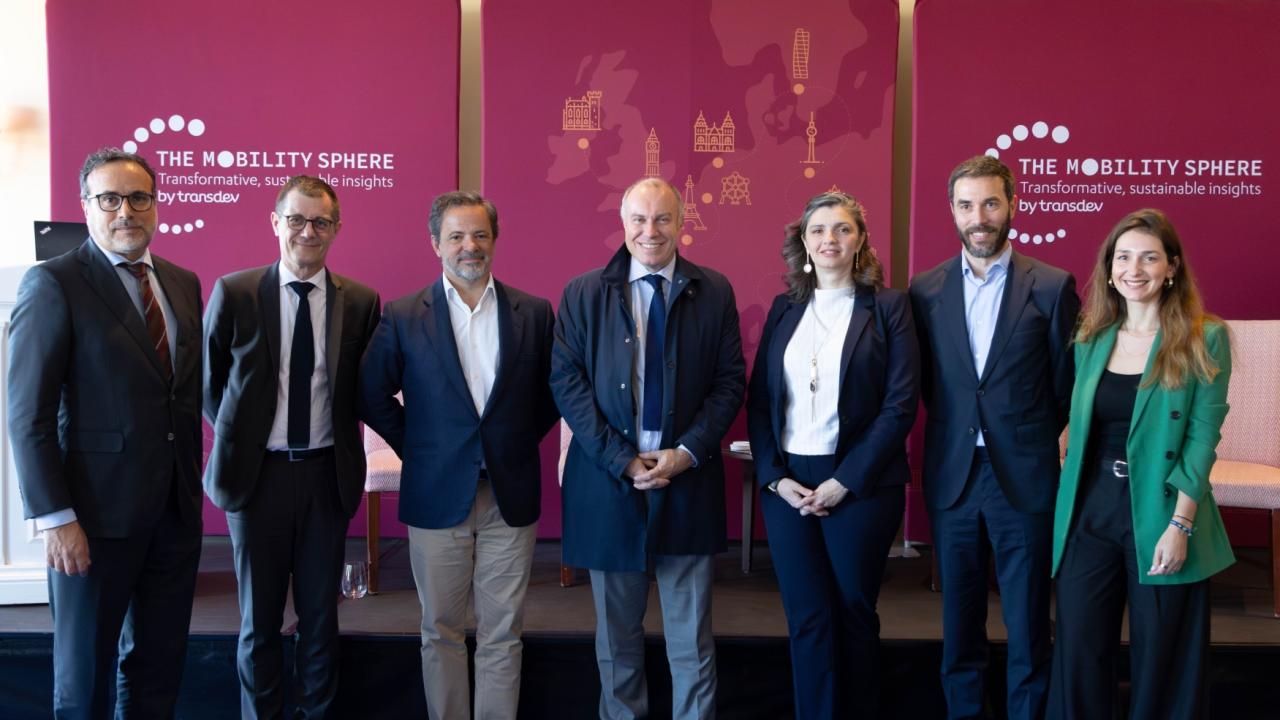
The Mobility Sphere think tank held its March 2026 meeting in Portugal, a country where the contrast between urbanised and rural areas is particularly stark – making it a good vantage point from which to explore the growing mobility divide between cities and the neglected areas in the EU.
Looking at Europe, it’s easy to get the impression that mobility policies are designed for big cities only, and neglect the rest of the territory, the Porto audience heard.
(00:00) Mobility is at the heart of territorial development and is a very important factor of social and territorial cohesion in Portugal. The key element of a healthy territorial landscape is governance, ensuring that there is a clear vision and the necessary resources. Addressing low‑density territories, as well as suburban and urban areas, is essential to ensure real harmony between people, territories, and quality of life. (01:10) When we look at more rural areas, I would say that there is already a range of solutions that have been tested. There is no miracle solution, but we have to start somewhere. Flexible public transport, particularly demand‑responsive transport, can be one of the first solutions to initiate a project. (01:46) The goal is to provide more mobility for those who live far away, for those who lack accessibility or transport options, and to create a more equitable mobility system for everyone.
Speakers include:
- António Baldaque da Silva – Professor of Finance and Executive Director of the Centre for Sustainable Finance, Católica Lisbon School of Economics and Business.
- Carlos Oliveira Cruz – Professor of Transport Economics, Instituto Superior Técnico.
- Cecília Silva – Professor, Faculty of Engineering of the University of Porto, Director of the Research Centre for Territory, Transport and Environment.
- François Gemenne – IPCC Lead Author, Scientific Advisor, The Mobility Sphere.

““It’s particularly fitting to discuss this issue in Portugal, a country where most of the population is concentrated in large cities, ” the Mobility Sphere’s scientific advisor Francois Gemenne said as he opened the conference. Close to two thirds of Portugal’s population of 11 million live in cities, mostly in Lisbon, Porto and Coimbra. That imbalance is not just demographic, but political. “Mobility options transform the demography of a country, Gemenne said. ”
Speakers argued that unequal access to mobility between cities and other areas is a driver of broader inequality across the continent.

“ “If we don't have access to mobility, we don't have employment, we don't have social life, we don't have education,” said”
This feeds, warned Transdev’s Portugal CEO Sergio Soares, “a vicious cycle of desertification”.
At the same time, demographic trends are shifting. “People… prefer to live outside the big urban centers,” creating new patterns of demand that existing systems struggle to meet, noted Carlos Oliveira Cruz, Professor at Lisbon University’s Instituto Superior Tecnico.
“What is the layer that somehow allows access to all these services and all these opportunities? It's mobility.” Access to mobility should even be treated as a constitutional right, he argued.
Funding such a right is a central challenge, said Antonio Baldaque da Silva, Associate Professor (adjunct) and Executive Director of the Center for Sustainable Finance at Catolica Lisbon School of Economics and Business. “All the solutions that we are talking about here do not happen from thin air. They will need a lot, a lot of money,” he said.
Markets alone will not solve the problem: “Money flows where it should flow… where returns are good,” he said, warning that “trying to convince people that these are going to be money-making projects would be a fallacy.”
Instead, public policy must set the direction. “The question is not intervention, the question is intervention to what end?” he said, arguing that governments must “tilt economic rationale towards what is good for society.”
The service to low-density populated areas is “a collective responsibility of the country as a whole,” Baldaque da Silva said, adding: “We need to pay for that.”
Beyond funding, a lack of planning is a critical weakness that cannot be solved by adding mobility as an afterthought, “like a pill that you take to treat the symptoms, but that doesn’t solve the problem”, argued Cecilia Silva, a specialist for spatial and transport planning at Porto University.
Current policies have created dependency on cars by design. “If you don't have choices, you use the only choice you have,” she said, pointing to widespread car use as a constraint rather than preference.
Driving cars “in packed streets” is not freedom, she said. Instead, real freedom consists of having alternatives. “It means that if you don’t want to drive a car, you don’t have to.”
Technology was seen as both an opportunity and a risk. Oliveira Cruz called it “a tool”, warning that “technology should not dictate how our cities are going to evolve”.
But speakers also highlighted its potential, particularly in low-density areas, where AI can help forecast demand and design flexible, hybrid services.
Governance may be the most difficult barrier. “We need to have someone that is legitimised from a political point of view to make hard decisions,” Baldaque da Silva argued, calling for stronger regional authorities.
At the same time, communication failures undermine public support for public-sector action, said Oliveira Cruz. “There is a complete inability to explain what they are doing,” he said. “People are not stupid.”
Mobility never stands alone, but touches on wider subjects including governance, competence, freedom and the mutualisation of costs, Gemenne concluded.
At the end of the day, how we treat mobility reflects fundamental attitudes about “the society that we want to create together”, he said.



The Mobility Sphere is our European Think Tank that explores the future of mobility. Since its launch in 2023, it has brought together public and private stakeholders as well as academic experts to reflect on the mobility of tomorrow and co-design innovative and inclusive solutions.


Eco-friendly website
Latest page modification date :
B
This page is times lighter than average
Emissions from this page
Estimated calculation per visit
0.09
in grams
of CO2 equivalent
of CO2 equivalent