Present in 19 countries

Charting Mobility: The Voyage of a Sustainable Capitalist


Antonio Baldaque da Silva has strong ideas how the market economy can be harnessed for the good of mobility, honed by decades on Wall Street punctuated by the occasional trip across the Atlantic – in a sailboat
0:044 secondesWe have to remember uh that uh the market economies are to the service uh of populations and to our service and 0:1111 secondestherefore it's very important to understand how it is affecting communities and how we can cater again the markets to be uh better uh for the 0:2121 secondesoutcomes of those communities. Mobility would be a very uh important uh example of that. We are struggling with a 0:2828 secondesbalance between very exciting urban areas and less populated areas uh that 0:3535 secondesare um being scrapped from uh that contact. A good understanding what is the social value um that small local 0:4444 secondescommunities bring uh to the fabric of the country are quite important too. And so for us to understand what is that 0:5151 secondessocial value uh we would need to um uh to invest more uh on those communities and understand there is a trade-off 0:5959 secondesthere. Yes, we will invest more on those communities but to exchange in exchange we will have a country that is 1:071 minute et 7 secondessignificantly more balanced more united and uh and better for everyone.
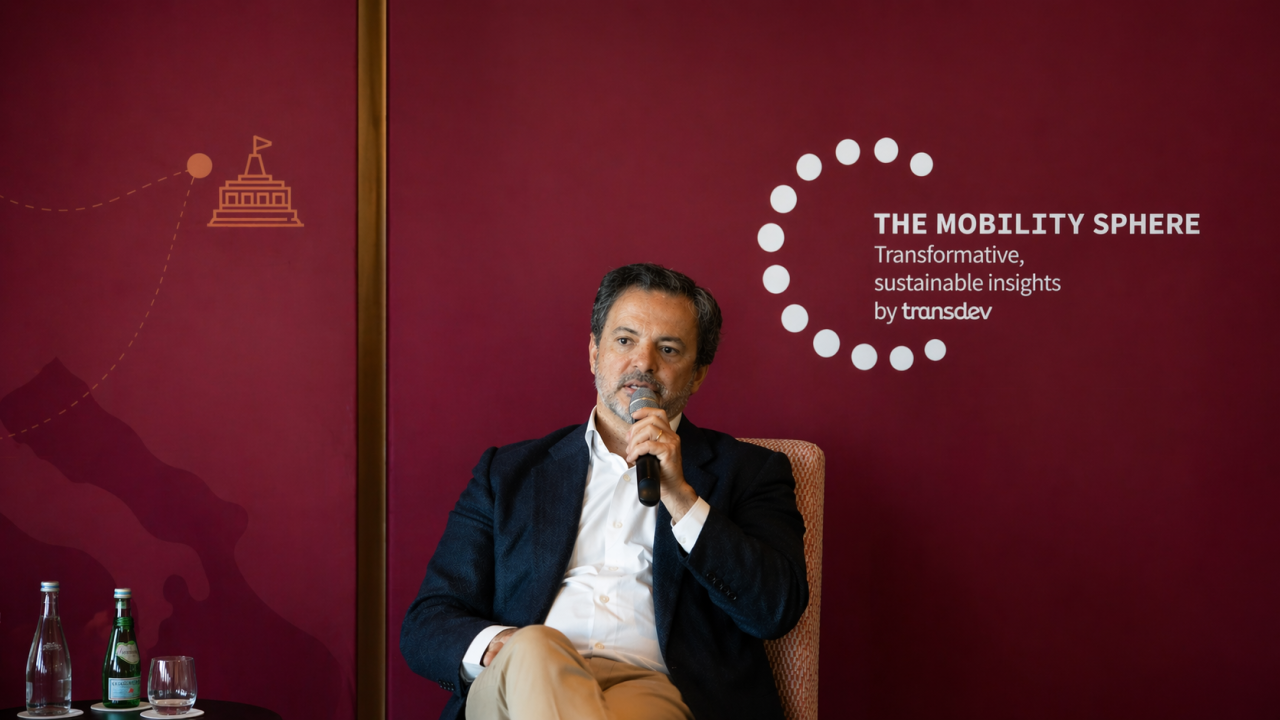
It’s refreshing when an expert leaves no doubt about where he is grounded. “I’m a capitalist,” Antonio Baldaque da Silva told the Mobility Sphere conference in Porto within seconds of taking the floor. But there’s nothing defensive or provocative in the way the finance specialist rolls out his credo. Instead, it’s a starting point for discussion.
“Market economies over the last 200 years have delivered amazing, amazing developments,” he stated.
But after 20 “very good years” on Wall Street, Baldaque da Silva has come to the conclusion that “we went a bit too far” and therefore “we need to think in a more sustainable way.”
He moved into academia and sustainable finance, where he now tries to reconcile market efficiency with social outcomes, using a highly practical approach: “Markets are fine, but a good understanding of what is the social outcome we want to get and how we can use markets… that’s the trick.”
His informed take on investment and money threw a unique light on the Mobility Sphere’s discussions about the best balance between what he calls “very exciting urban areas, and less populated areas that are being scrapped.”
Traditional finance would avoid such areas altogether because it is hard to generate money there. But for Baldaque da Silva, this is precisely where capitalism can and must evolve by widening its scope, and accept that not all benefits are monetary.
“It’s not only about money, it’s also about all the other benefits for communities,” he says. “We would need to invest more in those communities, and in exchange we will have a country that is significantly more balanced, more united.”
He cites as an example banks keeping open unprofitable branches. This, Baldaque da Silva argues, is the rational choice once “externalities” are properly valued.
Externalities – the costs or benefits of an economic activity that are not captured in its market price – are perhaps where Baldaque da Silva departs most from investment orthodoxy.
By putting a price on societal and environmental outcomes, governments can introduce a different logic into investment, offering private investors a new and productive way to measure returns.
In other words, the role of government is not to replace markets but to steer them. “This idea that government intervention is wrong, it’s totally bogus.”
If governments get regulation on topics like carbon emissions, bio-diversity and the integration of communities wrong, capital will continue to bypass the areas that need support the most. But if they get it right, “money flows”, Baldaque da Silva said.
Mobility systems, he argues, often suffer from decisions taken at the wrong level. “We need to have someone who is legitimized from a political point of view to make hard decisions.” Regional authorities, not fragmented municipalities or distant central governments, should carry that weight.
As if to underscore his taste for challenging orthodoxy, Baldaque da Silva enjoys a rare leisure activity: Crossing the Atlantic in a sailboat, something he has done “a few times”.
“It’s not a very efficient way to move,’ he admits, with a chuckle. Perhaps not, but it’s an inspiring illustration that a satisfying life is never about efficiency alone.
Eco-friendly website
The emissions calculation for this page is not yet available