Present in 19 countries

Has the green transition introduced social challenge in our society?


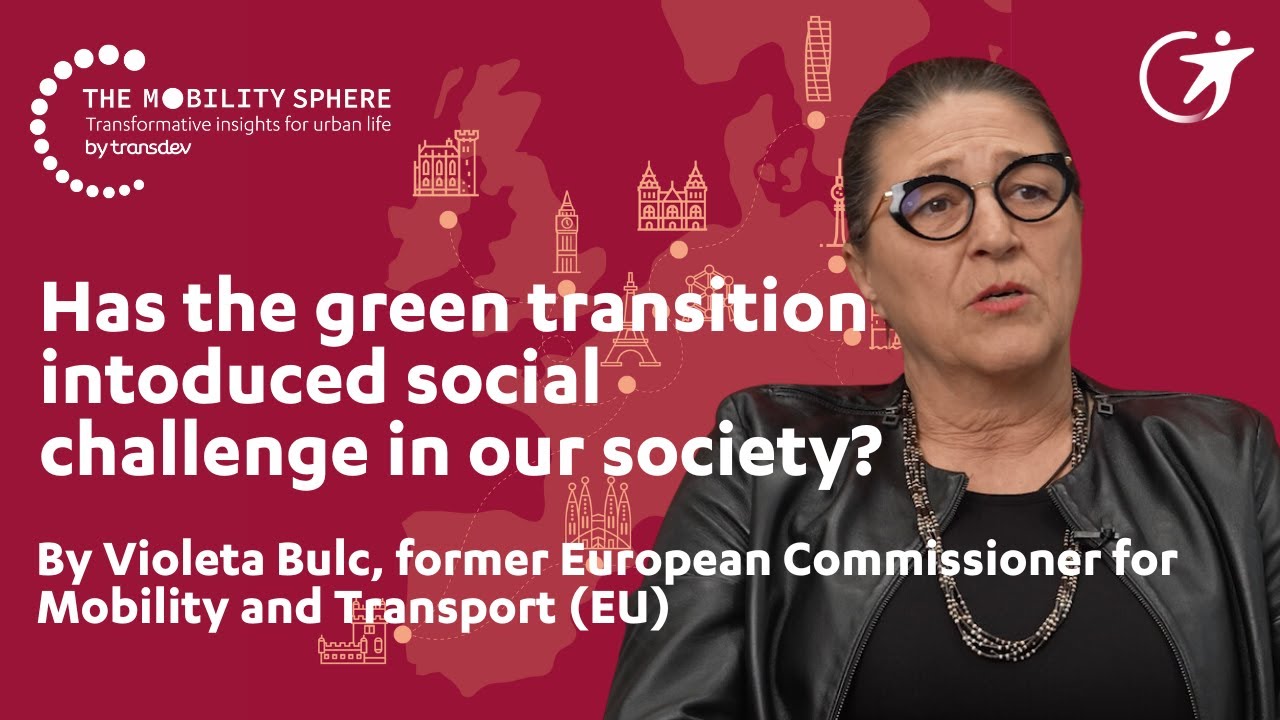
“If we stay focused on developing public transport, we can avoid [social challenges]. I believe mobility should first and foremost be public.” [00:09] “The private car could become a luxury or collector’s item for future generations. But to move around in an ecological, safe and efficient way, we need well‑integrated public transport, with a backbone structure and local loops.” [00:25] “The solutions for local loops are already excellent: small cars, mobility‑as‑a‑service (MaaS), pedestrian zones or other electric vehicles. But we’re still stumbling on the backbone because integration is not complete.” [00:51] “Because this structure is not efficient enough, many people say they don’t have time to take public transport or that it is not modern enough to meet the needs of today’s workers, who don’t want to waste time during their commute.” [01:12] “High‑speed trains are a great example: they are always full because they offer an environment that allows people to work or enjoy themselves. Time spent on the train thus becomes high‑quality working time.” [01:43]
In this video, Violeta Bulc, former European Commissioner for Transport, examines the social impact of the ecological transition on mobility.
In the EU, if we continue to focus on developing public transport, we can avoid creating new challenges. I believe that mobility should first and foremost be public.
To move around ecologically, safely and efficiently, it's crucial to have public transport well integrated into a solid structure, as well as a local network. Solutions in this area are already promising. The network can be made up of small cars, mobility-as-a-service (MaaS) solutions, bicycles, pedestrian zones or any other type of electric vehicle.
As far as the solid structure is concerned, this is where we are currently encountering difficulties, as integration is not yet complete. Because of this, many people say: “I don't have time to take public transport” or “It's not modern enough”.
Transport should meet the needs of working people who don't want to waste time in transit. High-speed trains are a perfect example of this, as they are always busy. Why is this? Because they offer an environment that is conducive to continuous productivity: you can work or spend pleasant moments there.

Eco-friendly website
Latest page modification date :
D
This page is times lighter than average
Emissions from this page
Estimated calculation per visit
0.23
in grams
of CO2 equivalent
of CO2 equivalent